Mar 01, 2023
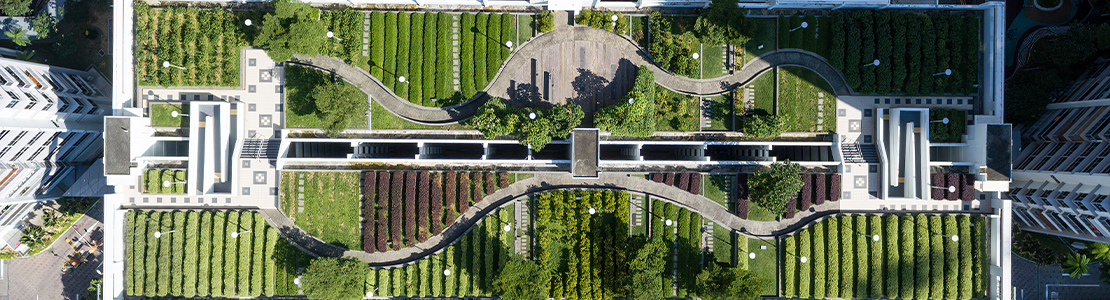
Net Zero Energy Building (ZEB) is an initiative to reduce a building’s annual energy consumption to net zero. Its benefits include lower utility costs, enhanced disaster resilience, and reduced environmental impact.
The YANMAR FLYING-Y BUILDING, Yanmar’s headquarters building, incorporates technologies such as solar power generation and a gas cogeneration system to become a Zero CO2 Emissions Building. Celebrating more than 100 years in business, it represents Yanmar’s commitment to its mission for the next century.
ZEB applies to commercial and public buildings, while Net Zero Energy House (ZEH) applies to residential properties. Both aim to achieve net-zero or near-zero annual energy consumption through improved energy efficiency and on-site generation, with their primary difference being the type of buildings they target.
Because ZEB covers a wider range of building types and industries, it is more difficult to achieve than ZEH. To address this, four achievement levels have been established:
(1) ZEB: Net annual energy balance effectively zero
(2) Nearly ZEB: Energy use reduced by at least 75 %
(3) ZEB Ready: Equipped with advanced energy-saving systems, prepared to achieve further reductions
(4) ZEB-oriented: Designed to move toward ZEB Ready
Advantages of ZEB / ZEH are:
Compared to standard buildings, ZEB / ZEH significantly reduces utility expenses and lessens the impact of rising electricity prices.
During power outages caused by natural disasters, buildings equipped with solar power and on-site/off-site generation systems can ensure safe living conditions and continued business operations.
Energy conservation and generation efforts make a direct contribution to addressing global environmental challenges.
Additionally, adopting ZEB / ZEH technologies can enhance the asset value of homes and buildings.
The main drawback is the higher initial cost, as high-performance equipment and better insulation are required compared to conventional buildings. However, subsidies are available for ZEB / ZEH projects, and as noted above, reduced utility costs often make them more economical in the long run.
Yanmar’s headquarters is located in Kita-ku, Osaka—the city where the company was founded. The YANMAR FLYING-Y BUILDING, which showcases the world’s most advanced environmental technologies, serves as a conceptual model pointing toward the future.
The building incorporates a wide range of CO2 reduction technologies, including solar thermal collectors, solar power generation, gas heat pump air conditioners, and gas cogeneration systems. Through the active utilization of CO2, Yanmar is working to realize a ZEB.
With over a century of history, Yanmar is committed to shaping the next 100 years. This building serves as a symbol of this commitment, embodying the company’s mission of “Achieving higher living standards by living together with nature.”